Choosing a bed for a loved one with dementia reshapes daily caregiving in ways most families don’t anticipate. Mobility changes, fall risks climb through the night, and comfort needs shift alongside cognitive symptoms. The right setup eases transfers, supports safer sleep, and turns a clinical purchase into something that still feels like home.
A Quick View Of The Lineup
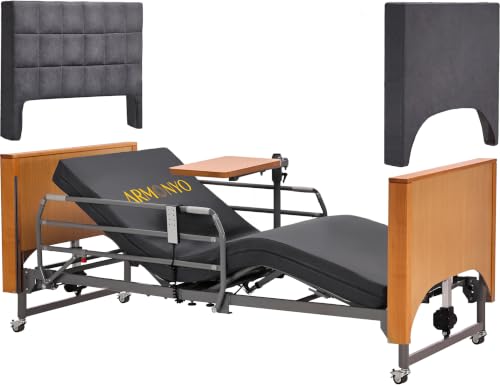
Hospital Bed for Home Use, German Motor
Electric Hospital Bed and Mattress for Home Use

Premium Hospital Bed 3 Function with Memory Foam Mattress

Real Relax Premium 3 Function Full Electric Hospital Bed

Vive Adjustable Bed Base Frame Twin

Hospital Bed Electric 3 Function with Dining Table

5 Function 600LBS Full Electric Hospital Bed

Point A PAM-3 Premium Full Electric Hospital Bed
Why These Options Stand Out
For households that want hospital-grade positioning without the clinical look, this ARMONYO five-function bed bridges that gap cleanly. The solid wood headboard and footboard panels, paired with optional upholstered covers, keep the frame from feeling like a sterile ward. Caregivers managing dementia patients who wake disoriented at night often tell me the homier frame helps reduce anxiety compared to bare steel alternatives.
Five electric functions, including Trendelenburg positioning (where the head tilts below the heart to support circulation) and reverse Trendelenburg, give this model flexibility that simpler three-function beds lack. An 8.5-inch ultra-low height cuts fall risk during restless nighttime movement. The German motor runs quiet enough for repositioning without waking light sleepers, which matters when sundowning (late-day confusion common in dementia) already disrupts rest.
What It Does Well
- Five electric functions allow caregivers to handle transfers, meals, and pressure relief from one handset.
- Residential wood panels preserve dignity and blend into a bedroom setting.
- Low-height 8.5-inch setting reduces fall severity for restless sleepers.
- Quiet German motor supports overnight repositioning without waking the patient.
Things To Consider
- The mattress is sold separately, which adds a step caregivers sometimes overlook.
- Full assembly typically requires two people and a clear floor plan.
At A Glance
Who It Suits Best
Families caring for a dementia patient at home who want full positioning control and a residential look rather than an institutional frame.
Where Another Pick Suits Better
For caregivers who want a bundled mattress to skip a second purchase, the Electric Hospital Bed and Mattress for Home Use from ARMONYO is the more streamlined setup.
When I look at what slows families down during setup, it’s almost always the mattress question. This ARMONYO model ships with a high-density dual-layer foam mattress built around a 2.1 lb base for support and a 1.9 lb top layer for pressure distribution. For dementia patients who spend long stretches in bed, that balanced layering matters more than marketing language suggests.
The bed itself carries the same German LIMOSS motor and residential wood-panel design as the first ARMONYO entry, plus a wired handset. Height adjusts from 8.5 to 25 inches, the backrest reaches 70 degrees, and Trendelenburg positioning is built in. Caregivers running night shifts in small homes appreciate that the motor stays nearly silent during repositioning.
Points In Its Favor
- Included dual-layer foam mattress removes a separate purchase decision.
- Height range of 8.5–25 inches supports both fall safety and caregiver ergonomics.
- Quiet LIMOSS motor keeps repositioning discreet through the night.
- Wood-panel construction keeps the bedroom feeling like a bedroom.
Worth Noting
- Wired handset limits where caregivers can stand during adjustments.
- Foam mattress cover cleaning requires specific care to avoid moisture damage.
Made For
Households that want a complete bed-and-mattress bundle without piecing together a separate foam order.
Consider Something Else When
Shoppers needing memory foam pressure relief should look at the Premium Hospital Bed 3 Function from GOTBRAN, which includes a 4.7-inch memory foam mattress.
Pressure injuries are a quiet concern in dementia care, especially as mobility decreases. GOTBRAN addresses that directly by pairing a full-electric frame with a 4.7-inch memory foam mattress, which contours to bony areas better than standard foam. For a patient who spends hours without repositioning, that surface change alone can matter.
The frame runs three classic functions: a backrest reaching 75 degrees, knee height up to 45 degrees, and overall bed elevation between 16.5 and 26.8 inches. A JIECANG control system powers adjustments through a bedside pendant. Central locking 5-inch casters stabilize the frame during transfers, which is one detail caregivers often overlook when comparing options.
A Few Strong Suits
- Memory foam mattress reduces pressure point discomfort during long bed rest.
- Central locking casters prevent rolling during patient transfers.
- JIECANG motor system delivers smooth, consistent adjustments.
- Backrest range up to 75 degrees supports upright reading or feeding positions.
Room For Improvement
- Three-function design lacks Trendelenburg positioning for advanced care needs.
- Minimum 16.5-inch height is higher than competitor low-position frames.
Feature Snapshot
Right Fit For
Dementia patients who need pressure-relief sleep surfaces and caregivers who prioritize transfer stability.
Look Elsewhere When
If ultra-low fall-safety positioning matters more than memory foam comfort, the Hospital Bed for Home Use from ARMONYO drops to 8.5 inches.
Real Relax goes straight at households that need capacity and accessories in one box. The 530-pound loading limit handles heavier body types without the wobble some lighter frames show over time. For dementia patients who also struggle with weight, that margin of safety changes how confidently caregivers approach transfers.
The package includes a mattress, IV pole, locking casters, and two fitted sheets, which removes several decisions from the shopping list. Three electric functions cover the backrest up to 80 degrees, knee rest up to 45 degrees, and full bed height between 16.3 and 28.3 inches. A handheld controller keeps operation straightforward for family caregivers.
Standout Benefits
- 530-pound capacity handles higher-weight patients with steady support.
- Sheets, mattress, and IV pole arrive together to simplify setup.
- Backrest to 80 degrees enables a near-vertical seated position.
- Locking casters prevent drift during caregiving moments.
Trade Offs
- Three-function frame lacks Trendelenburg positioning.
- Higher minimum height than ARMONYO’s ultra-low frame.
Best Suited To
Family caregivers supporting heavier dementia patients who want an all-in-one accessory package.
A Better Fit Elsewhere
Caregivers needing true clinical positioning should consider the 5 Function 600LBS Full Electric Hospital Bed from DAHAIY for Trendelenburg support.
Not every home has space for a hospital bed frame. The Vive adjustable base in twin sizing slips into a standard bedroom layout while still delivering head, leg, and foot incline adjustments. For dementia patients in apartments or shared living situations, the smaller footprint removes a common source of friction.
Independent head and foot positioning lets caregivers raise just the head for reflux or just the legs for circulation. Dual USB ports built into the frame handle phone charging, which matters when monitoring devices or bedside tablets need power overnight. Heavy-duty metal construction supports a hospital mattress without flexing.
Everyday Advantages
- Twin footprint fits standard bedrooms and tight layouts.
- USB ports keep monitoring devices charged at the bedside.
- Independent head and foot positioning supports varied comfort needs.
- Metal platform handles a medical-grade mattress without flexing.
Honest Caveats
- No full hospital-grade height adjustment range.
- Mattress sold separately from the base frame.
- Lacks Trendelenburg positioning for advanced clinical care.
Perfect Match For
Dementia patients in apartments or smaller bedrooms where a full hospital frame would overwhelm the space.
Skip It When
Caregivers needing fall-prevention ultra-low height should consider the ARMONYO Hospital Bed for Home Use with its 8.5-inch low setting.
Mealtimes become complicated when a dementia patient can’t sit at a table. RESTISLAND addresses that with a built-in dining tray that slides over the mattress, turning the bed into a usable surface for breakfast, medications, or activities. Caregivers running the day on their own often find this small accessory reshapes daily routines more than expected.
The three-function frame mirrors the Real Relax spec range, with a backrest up to 80 degrees, knee rest at 45 degrees, and height between 16.3 and 28.3 inches. A 530-pound capacity keeps the frame stable, and the 4.7-inch foam mattress arrives in the box alongside the IV pole. Locking 5-inch casters prevent drift during transfers.
The Helpful Details
- Included dining tray supports in-bed meals and quiet activities.
- Sheet set included alongside mattress and IV pole.
- Locking 5-inch casters stabilize the frame during caregiving.
- Remote control operation simplifies adjustments for family use.
Points To Note
- Three-function design lacks Trendelenburg positioning.
- Dining tray requires removal before full flat sleep positioning.
Who Will Love This
Dementia patients who eat meals in bed and caregivers who want activity-friendly surfaces for crafts, reading, or medication routines.
Reach For A Different Pick When
For Trendelenburg and reverse positioning needs, the DAHAIY 5 Function 600LBS bed offers the extra clinical adjustments.
DAHAIY built this bed for households that have crossed past basic care into something closer to clinical territory. The 600-pound capacity is the highest in this roundup, and four smooth motors power adjustments quietly enough that they don’t interrupt conversation during repositioning. For dementia patients with significant mobility loss, the extra motor headroom translates into fewer mechanical hiccups.
Five functions span backrest, legrest, bed height, plus Trendelenburg and reverse-Trendelenburg positions. The tilt options support circulation and breathing concerns that sometimes accompany later-stage dementia. The included mattress and IV pole round out the package for caregivers who prefer fewer separate orders.
Everyday Perks
- 600-pound capacity accommodates heavier patients with structural confidence.
- Trendelenburg and reverse-Trendelenburg support circulation and respiratory needs.
- Four quiet motors handle multiple adjustments without disturbing the room.
- Mattress included so caregivers don’t chase a separate foam order.
Some Limits To Know
- Larger frame footprint may not suit compact bedrooms.
- Five-function complexity adds a learning curve for family caregivers.
Quick Facts
Built With In Mind
Households managing advanced dementia where clinical positioning and high weight capacity both matter.
Where A Sibling Pick Shines
For a quieter bedroom aesthetic with solid wood panels, the ARMONYO Hospital Bed for Home Use offers a warmer residential look.
A Point A Tech leans into refinement over raw capacity. The LINAK motor system, engineered in Denmark, is the same platform used in many European hospital beds, and the motion it produces is smoother than generic aftermarket motors. For households sensitive to nighttime noise during repositioning, that polish is the entire point.
Three functions cover head, foot, knee, and height adjustment between 15 and 24 inches. The 4.7-inch foam mattress is built in the USA, which matters to caregivers who want supply-chain transparency for long-term use. Individual-locking 5-inch casters let caregivers stabilize one wheel at a time, useful on uneven floors. A dining tray and two sheets round out the bundle.
What Makes Sense
- LINAK motors deliver smooth, near-silent adjustments for light sleepers.
- USA-made foam mattress offers supply-chain transparency.
- Individual-locking casters stabilize the frame on uneven flooring.
- Tray and sheets included for immediate setup.
Practical Considerations
- Three-function design omits Trendelenburg positioning.
- Higher minimum 15-inch setting may not suit fall-prevention routines.
The Right Fit
Caregivers prioritizing quiet motor performance and a complete accessory package for a calmer bedroom environment.
Swap It Out When
For ultra-low fall-safety positioning, the Hospital Bed for Home Use from ARMONYO offers a lower 8.5-inch minimum height.
Choosing The Right Bed Setup For Dementia Care At Home
Height Range And Fall Safety
The single most important spec on any dementia bed is how low it goes. Falls during nighttime wandering or bed-exit attempts cause more ER visits for dementia patients than almost any other incident. Frames that drop to 8.5 inches reduce the height of a fall, while frames starting at 15 inches or higher add risk during restless movement.
Function Count And Positioning Needs
Three-function beds cover the basics: backrest, knee, and height. Five-function frames add Trendelenburg and reverse-Trelenburg, which help with circulation and breathing. For early-stage dementia, three functions usually suffice. Households managing later-stage symptoms benefit from the extra positioning range, especially when respiratory changes appear.
Mattress Decisions
Pressure injuries develop quickly in patients who can’t reposition themselves. Memory foam or high-density dual-layer foam distributes weight better than basic innerspring. Bundled mattresses, like the GOTBRAN or ARMONYO options, remove the second purchase decision and ensure the foam matches the frame dimensions.
Key Considerations Across These Picks
Mistakes Worth Dodging
Buying a bed without checking the mattress height against existing bed rails is one of the most common missteps. Rails that fit a standard mattress may gap dangerously on a hospital foam surface. Measure first, and confirm rail compatibility before adding accessories. Another trap is choosing a frame on capacity alone and ignoring minimum height, since fall risk depends more on how low the frame drops than how much weight it holds.
Where The Extra Money Goes
Higher-tier models earn their cost through motor quality, positioning range, and accessory bundling. A German LIMOSS or Danish LINAK motor lasts longer and runs quieter than generic alternatives. Trendelenburg positioning adds clinical capability that basic frames can’t replicate. Bundled mattresses, sheets, and IV poles save separate purchases and ensure the components fit the frame as a system.
Frequently Asked Questions
What bed height is safest for dementia patients?
Ultra-low beds that drop to around 8.5 inches reduce fall impact during restless nighttime movement. The lower the minimum height, the smaller the risk when a patient attempts to exit the bed unassisted.
Do hospital beds come with mattresses?
Bundled options like the ARMONYO Electric Hospital Bed or GOTBRAN Premium Hospital Bed include a foam mattress. Frames sold without mattresses require a separate purchase matched to the frame dimensions.
What is Trendelenburg positioning?
Trendelenburg tilts the bed so the head sits below the legs, which supports circulation and certain respiratory needs. Reverse-Trendelenburg does the opposite. Five-function beds typically include both options.
How wide are home hospital beds?
Most home hospital beds run about 36 inches wide, matching a standard twin mattress. Compact adjustable bases like the Vive twin frame fit tighter bedroom layouts.
Can a hospital bed look residential?
Wood-panel headboards and footboards, like those on the ARMONYO models, soften the clinical look. Upholstered covers add a finishing touch that blends into a standard bedroom.
The Takeaway
The right bed for a dementia patient depends on fall risk, mobility level, and how much clinical positioning the household actually needs. Match the frame’s minimum height to the patient’s fall risk, choose mattress quality based on time spent in bed, and only pay for Trendelenburg functions if advanced care is on the horizon. For most households, a solid three-function frame with a quality foam mattress covers daily life well.