A bad night in bed can mean a bad morning on the floor. For older adults living at home, the right bedside rail does two quiet jobs at once: it keeps a sleeping person from rolling out, and it gives a half-awake body something solid to grab when standing up. Falls around the bed are among the most common injuries for seniors, so the gear that prevents them earns its space. I put this list together for caregivers shopping on behalf of a parent, for adults adapting their own bedroom after surgery, and for anyone outfitting a spare room for an aging relative. The eight picks below mix full guard rails, assist handles, hospital-style pads, and a bathroom add-on that pairs naturally with any bedside setup.
A Closer Look At The Lineup

Kohentact Bed Rail Bumpers Foam Guard with Straps

Skil-Care Half-Size Bed Rail Pads Vinyl 401090-2PC

Lunderg Bed Assist Rail with Motion Light

YrHeiper Bed Rails with Bedside Support Legs
YrHeiper Bed Rails 350LBS Heavy Duty Grab Bar

YrHeiper Raised Toilet Seat with Arm Rests
Stander EZ Adjust Bed Rail with Organizer Pouch

Healthcraft Assista-Rail Fixed Bed Rail with Organizer
A Breakdown Of The Leading Choices
The Kohentact bumper takes a different angle from the metal rails elsewhere on this list. It is a foam guard rather than a rigid bar, intended for beds where the worry is a rolling sleeper bumping into a hard frame or, in some setups, falling off a low mattress. A breathable mesh-style cover sits over the foam, and adjustable straps wrap under the mattress to keep the pad from drifting overnight.
For households with a toddler in one bed and an older adult in another, this kind of soft barrier can pull double duty. It cushions incidental contact more than it prevents a determined roll-off, which makes it a smarter companion piece than a standalone safety system for someone with serious fall risk.
Strengths Worth Knowing
- Adjustable straps grip the mattress from below, which keeps the pad anchored during restless nights.
- The washable cover handles spills and accidents with a simple wipe-down, useful in long-term care settings.
- Soft construction reduces bruising when an arm or leg meets the edge of the bed.
- Works across mattress depths, so it does not lock you into one bed type.
Things To Consider
- A foam bumper does not give a person something firm to grab when standing up, so it is not a true assist handle.
- Owners commonly report that the straps need re-tightening after a few weeks of routine use.
Right Fit For
Caregivers outfitting a bed for someone with dementia or restless sleep who is at low-to-moderate fall risk.
Look Elsewhere When
You need a real grab handle for standing transfers, in which case the Lunderg Bed Assist Rail with Motion Light offers that grip plus a built-in night light.
Skil-Care makes a product for a specific setup: a half-length metal rail already mounted to a hospital-style bed. These pads slide over the patient-facing side of that rail and cushion the metal against limbs, which matters in any room where a sleeper’s arm or leg could get wedged between the rail bars.
Vinyl covers handle incontinence and spills better than fabric, so caregivers working in long-term care settings tend to favor this material. Snap-and-hook closures at top and bottom keep the pad from sliding during repositioning or linen changes, which is a quiet but real benefit during the night shift.
Bright Spots
- The wipe-clean vinyl surface holds up well to repeated disinfection routines.
- Snap closures hold through patient repositioning, reducing how often the pad needs refitting.
- Sized for half-length rails, so it does not bunch or sag on shorter frames.
Worth Noting
- It only makes sense in a room where a rigid metal rail is already installed, otherwise the pad has nothing to attach to.
- Vinyl can feel warm against skin in summer, so lightweight bedding on top helps with comfort.
Made For
Caregivers in nursing or hospice settings who need a protective overlay for an existing metal bed rail.
Swap It Out When
The bed in question has no rail to cover, in which case the Stander EZ Adjust Bed Rail with Organizer Pouch gives a complete, certified system in one piece.
The Lunderg rail leans into the part of fall risk that happens after dark. A motion-activated light turns on when someone sits up or swings their legs off the mattress, casting a soft glow across the floor toward the bedroom door. For seniors who make a bathroom run two or three times a night, that small pool of light can keep a sleepy foot from catching a stray slipper.
The rail itself is built around a non-slip grab handle, and that ergonomic grip is where the rail earns its keep during transfers. Compared to the foam Kohentact guard earlier in this list, this is a true assist tool: the user pulls up on the bar rather than rolling into a soft edge.
What Earns Its Place
- Motion light cuts down on fumbling for a lamp switch at 3 a.m.
- Non-slip handle gives confident grip, even with damp or arthritic hands.
- Lower profile than a full guard rail, which suits people who do not want a hospital look in the bedroom.
Trade Offs
- Motion light needs batteries, so a quick check every few weeks avoids dead-light surprises.
- Lower rail height means it helps with sitting and standing more than with preventing roll-offs for restless sleepers.
Best Suited To
Older adults who get up several times a night and need a steady grip plus soft pathway lighting.
Consider Something Else When
Fall prevention during sleep is the main concern, in which case the Healthcraft Assista-Rail Fixed Bed Rail with Organizer offers a taller, fixed profile that stays put.
Where many bedside rails rely on the mattress itself to anchor the frame, this YrHeiper model adds a stabilizing leg that reaches the floor. That single leg changes the physics of the setup: instead of the user’s weight pulling sideways on a mattress, the load travels straight down through the rail into the floor.
The frame is rated for 350 lbs, which puts it in the conversation for larger seniors or for anyone who puts real force on the bar during transfers. The certified build references the ASTM F3186-17 standard, the same benchmark cited on the Stander and Healthcraft rails further down this list.
Everyday Advantages
- Floor leg keeps the rail planted, which helps during forceful stand-up movements.
- High weight rating opens the door for users who would stress lighter frames.
- Certified to a recognized adult bed rail safety standard, which is reassuring for family caregivers.
Points To Keep In Mind
- The floor leg needs clearance next to the bed, so tight spaces can complicate placement.
- Assembly is more involved than strap-on designs, and you may want a second pair of hands during install.
Who It Suits Best
Seniors who lean hard on the rail during transfers and need the floor leg doing some of the anchoring work.
A Better Fit Elsewhere
Tight bedrooms where a floor leg simply will not fit, in which case the Lunderg Bed Assist Rail with Motion Light offers grab-bar support without the floor footprint.
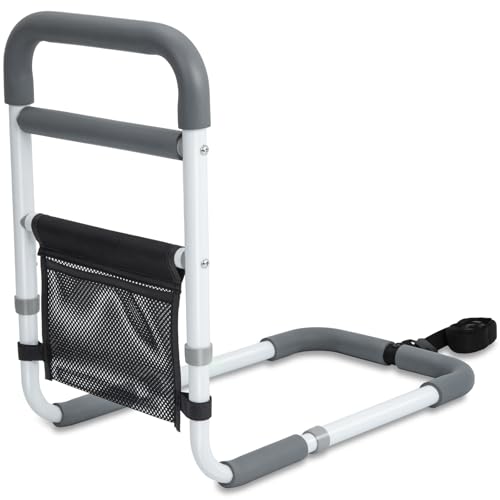
This is the sibling model to the previous YrHeiper pick, and it shares the 350 lb capacity rating along with the same ASTM safety standard reference. The frame is built around a heavy-duty grab bar rather than a stabilizing leg, which gives it a simpler install under the mattress. For shoppers who liked the heavy-duty feel of that first YrHeiper but do not have the floor clearance for a leg, this one fits the bill.
The soft, non-slip grip on the bar gives a confident hold even when the user’s hands are not fully dry. For daily transfers, that grip texture is where the comfort lives, and it tends to matter more than the cosmetic finish once the rail has been used a few dozen times.
The Upside
- No floor leg means easier placement in smaller bedrooms.
- Non-slip grip texture supports users with arthritis or reduced hand strength.
- Certified to a recognized adult bed rail safety standard.
Honest Caveats
- Without the floor leg, all the load transfers through the mattress, so a heavier user may feel the bed shift slightly.
- Strap-on fit varies with mattress thickness, so check compatibility before installing on a low-profile foam mattress.
Perfect Match For
Seniors who want sturdy grab-bar support and a simpler install than a floor-leg model.
Not Your Match When
The user routinely puts heavy force on the rail, where the YrHeiper Bed Rails with Bedside Support Legs takes that load down to the floor.
A bedside rail only covers half of the daily transfer problem. The other half is the bathroom, and that is where this raised toilet seat earns its place on a list about bedroom safety. It fits over an existing round or elongated seat and adds 2 to 3 inches of lift, which is the height difference that often determines whether a senior sits down or slowly drops.
Armrests on either side give a place to push off from when standing, and the locking straps underneath keep the seat from sliding on the porcelain. The ABS frame supports up to 300 lbs and is light enough to remove for cleaning, which matters in any shared bathroom.
Points In Its Favor
- Tool-free install means caregivers can set it up without dragging out a toolbox.
- Lift options let you tune the height to the user rather than forcing one setting.
- Armrests provide push-off leverage that mirrors the grip a bedside rail offers.
A Few Limitations
- It is a toilet-side solution, not a bedside one, so it does not replace the bedroom rails on this list.
- Locking straps work best on standard toilet shapes, so check fit if the bathroom has an unusual bowl.
Built With In Mind
Seniors pairing bathroom safety with a bedroom rail so transfers in both rooms feel manageable.
Reach For A Different Pick When
Bedroom fall prevention is the only priority, where the Stander EZ Adjust Bed Rail with Organizer Pouch covers that need in one piece.
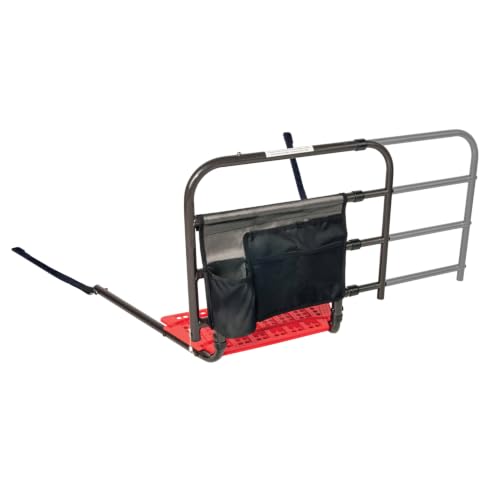
The Stander rail is the most versatile full-length option on this list. The guard telescopes from 20 to 30 inches, so the same rail can serve a smaller sleeper in a low-profile bed or a taller user in a higher mattress. That adjustability also matters over time, since the rail can grow with a household’s changing needs rather than being replaced.
Built to the ASTM F3186-17 standard, this is one of the more established certified rails in the consumer market. The integrated organizer pouch keeps a phone, glasses, and a remote within arm’s reach, which sounds small until you realize how often a half-awake senior reaches across the bed for those very items.
What Pays Off
- Telescoping length adapts to different mattress heights and sleeper sizes.
- ASTM certification gives caregivers a documented safety benchmark.
- Organizer pouch keeps essentials off the nightstand and within easy reach.
- Functions as both a fall guard and a stand-assist handle.
Where It Is Less Suited
- Full-length design takes up more bedside space than a compact assist bar like the Lunderg.
- Heavier than foam-based options, so bed repositioning requires more effort.
Quick Facts
Who Should Grab It
Households where one rail needs to cover changing fall risk levels, different mattress depths, or multiple users over time.
Where Another Pick Suits Better
Bedrooms that are too narrow for a full-length guard, where the Stander’s footprint crowds the space, the Healthcraft Assista-Rail Fixed Bed Rail with Organizer gives a more compact fixed profile.
The Healthcraft Assista-Rail takes the fixed-mount approach, meaning the rail is installed in one configuration rather than telescoping. That sounds like a step back from the adjustability of the Stander, but it pays off in long-term stability: fewer moving parts means fewer things that can loosen or rattle after months of daily use.
Built to the same ASTM safety standard as the other certified rails on this list, it also ships with a small organizer pouch for the same bedside essentials. For households committing to a permanent bedroom safety setup, the fixed profile is often the more reassuring choice over time.
A Few Highlights
- Fixed mount keeps the rail planted in the same position night after night.
- ASTM-certified design meets an adult portable bed rail safety standard.
- Organizer pouch adds the same reach-friendly storage as the Stander rail.
- Sturdy construction suits long-term install rather than short-term recovery.
Possible Compromises
- No telescoping length, so the rail must match the bed height at install time.
- Fixed-mount install is more involved than strap-on designs.
Key Product Details
Whose Shelf It Belongs On
Households installing a long-term bedroom safety setup where adjustability matters less than lasting stability.
Skip It When
The bed height changes often, or the rail will move between rooms, in which case the Stander EZ Adjust Bed Rail with Organizer Pouch adapts more readily.
What To Weigh Before Picking A Bedside Safety Setup
The first decision is between a guard rail and an assist handle. A guard rail runs along the edge of the mattress to keep a sleeper from rolling off, and it doubles as a place to grab when sitting up. An assist handle is shorter, mounted at the head or side of the bed, and is primarily built for the stand-up motion. Seniors who rarely roll toward the edge but struggle to rise in the morning usually only need an assist handle. Seniors with dementia, restless sleep, or a history of nighttime falls usually need a guard rail.
The second decision is mounting style. Strap-on rails slide between the mattress and the box spring, and they travel well when a caregiver is moving a parent between homes. Floor-leg or fixed-mount rails take more effort to install, but they hold their position more reliably under heavy load. The trade-off is convenience versus long-term stability, and the right answer depends on whether the rail is staying put or moving with the family.
The third decision is safety certification. ASTM F3186-17 is the standard that covers adult portable bed rails, and it covers the specific risks that come with this category, including entrapment (where a body part gets wedged between the rail and the mattress) and falls over the rail. Certified rails are tested for both. Buyers who skip the certification step sometimes end up with rails that look sturdy but fail the entrapment test, and that is a quiet kind of risk worth avoiding.
Finally, think about the mattress itself. Low-profile foam mattresses can change how a strap-on rail sits, and a too-thin mattress may leave too much gap between the rail and the sleeping surface. Measure mattress depth before ordering, and keep the gap small enough that an arm cannot slip between rail and mattress during sleep.
Key Considerations Across These Picks
Common Slip Ups
The most common mistake is buying a rail that is too short. A rail that only covers a third of the bed looks tidy but does little for a sleeper who rolls toward the middle of the mattress. Measure the bed length and pick a rail that covers the portion of the mattress where the sleeper actually moves at night.
Another frequent miss is ignoring mattress thickness. Strap-on rails depend on a snug fit between mattress and box spring, and mattresses thinner than about 8 inches can leave the strap loose. When the strap is loose, the rail shifts, and a shifting rail is almost the same as no rail at all.
Where The Extra Money Goes
Higher-tier rails tend to buy three things: certification, build quality, and adjustability. Certified rails are tested against entrapment and fall benchmarks, which is meaningful safety work that costs real money. Heavier-gauge steel and welded frames hold up better under daily grabbing and pulling, and they tend to look less rattly after a year of use. Telescoping or fold-down designs, like the Stander rail, add moving parts that need to last through thousands of adjustments, and that engineering shows up in the price.
For households with permanent bedroom setups, the upgrade is usually worth it. For short-term recovery situations, a simpler strap-on rail often does the job at a lower cost.
Frequently Asked Questions
What is the safest bed rail for elderly adults?
There is no single safest rail for everyone, but rails built to the ASTM F3186-17 standard have been independently tested for entrapment and fall risk. Within that certified group, the right rail depends on mattress depth, weight capacity, and whether the rail needs to telescope or stay fixed.
How do I install a portable bed rail safely?
Strap-on rails slide between the mattress and the box spring, and the straps fasten under the bed. Always check that the strap is taut and that the rail sits flush against the mattress. Fixed-mount rails attach to the bed frame and require the hardware included with the rail, plus a basic tool kit.
Are bed rails covered by insurance or Medicare?
Coverage depends on the policy and on whether the rail is classified as durable medical equipment. Some Medicare Advantage plans reimburse bedside safety equipment with a prescription, while original Medicare often does not. Check with the plan administrator before ordering.
Can a senior get trapped in a bed rail?
Entrapment is the specific risk that ASTM F3186-17 testing is designed to prevent, which is why certified rails matter. The gap between rail and mattress, the opening at the rail ends, and the space under the rail are the spots where entrapment happens, so certified rails are tested at each of those points.
How long do bed rails typically last?
A steel frame rail in daily use tends to last several years before any finish wear or hardware loosening shows up. Vinyl pad covers, like the Skil-Care set on this list, usually last longer because they are easy to wipe down and rarely see heavy impact.
Final Verdict
A bedside rail does its best work quietly, in the hours when no one is watching. The eight picks above cover the main setups: soft foam bumpers for low-risk fallers, padded overlays for existing metal rails, assist handles for nighttime transfers, heavy-duty frames for stronger users, a bathroom add-on that finishes the safety loop, and two certified full-length rails for households that want the documented standard. Match the rail to the sleeper and the bedroom, and the gear does its job without taking over the room.